Love it or hate it, AI is here to stay. The interesting question is what we do with it.
Recently, DuckByte conducted a highly scientific experiment.
An AI brand-analysis tool was given the DuckByte website and asked to read the room.
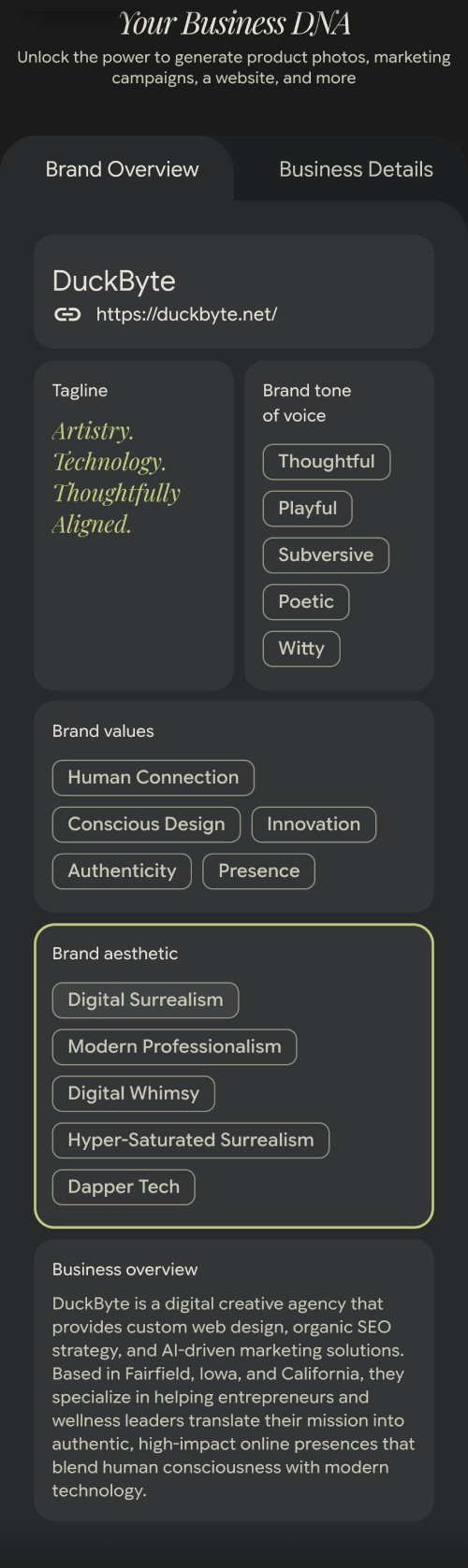
The results included Human Connection, Conscious Design, Subversive, Poetic, Witty and, inexplicably, Dapper Tech.
Naturally, there was an awards ceremony.
The philosophy here at DuckByte is simple: leverage AI for what’s creative and possible while keeping human creativity, judgment and oversight firmly in the equation.
But there’s another side to AI that’s becoming increasingly important for businesses online.
AI isn’t just helping us create things. It’s increasingly reading, interpreting and recommending them.
Which for your business website raises an interesting question:
How does AI see your business?
Does your website communicate clearly enough that an AI system can understand what you do?
More importantly, can AI understand what makes you different from everyone else doing some version of the same thing?
Your mission. Your values. Your personality. The things that aren’t easily reduced to a list of services and keywords.
So DuckByte became its own experiment.
Letting AI read the room
The DuckByte website was run through Pomelli, a free experimental Google Labs tool that analyzes a website and creates what it calls a business’s “Business DNA.”
Before generating marketing assets, Pomelli attempts to understand the business itself: its voice, values, aesthetic, messaging and overall identity.
That was the interesting part.
The point wasn’t to ask AI to tell DuckByte who it should be.
The question was whether AI could recognize who DuckByte already was.
And apparently, it could.
The voice it heard
Pomelli described DuckByte’s brand voice as:
Thoughtful. Playful. Subversive. Poetic. Witty.
Hard to argue with that. 😅
This may actually have been the most interesting part of the experiment.
Those aren’t services. They aren’t a list of SEO keywords. They’re qualities of communication.
Somehow, after reading the words, structure and presentation of the website, the system had picked up something closer to personality.
And that gets to the heart of why this matters.
A website shouldn’t merely tell people what you sell. Done well, it communicates something about who is behind it, what they value and how they think.
Increasingly, humans aren’t the only ones reading those signals.
That’s becoming part of the work of good web design: making sure AI understands what you do without translating your business into generic internet beige.
Then things got strangely specific
Pomelli identified DuckByte’s brand values as:
Human Connection • Conscious Design • Innovation • Authenticity • Presence
That felt remarkably close to the intention behind the site.
Then came the aesthetic analysis:
Digital Surrealism • Modern Professionalism • Digital Whimsy • Hyper-Saturated Surrealism • Dapper Tech
Also surprisingly accurate.
Although one member of the team may have taken Dapper Tech a little too seriously.
The larger experiment
The duck notwithstanding, there was something genuinely useful hiding inside this little experiment.
We’re entering an online environment in which people may increasingly encounter businesses through AI-assisted search, recommendations, summaries and other forms of machine interpretation.
That makes an old web-design principle newly important:
Clarity matters. Humanity does too.
Can someone understand what you do?
Can they understand why you do it?
and more importantly, can they distinguish you from the fifteen other businesses offering something superficially similar?
And after all of the keywords, structure and technical machinery have done their jobs, is there still enough humanity left in the signal for something unmistakably you to come through?
AI can help us build things faster. It can analyze, generate, organize and amplify.
But the goal shouldn’t be handing creativity over to the machine.
The interesting territory is the collaboration: human intelligence leveraging artificial intelligence, with human creativity, judgment and oversight still steering the ship.
Or, in this particular case, apparently steering the Waymo.
DuckByte’s experiment ended with an AI successfully identifying the business as thoughtful, playful, subversive, poetic, human-centered and professionally surreal.
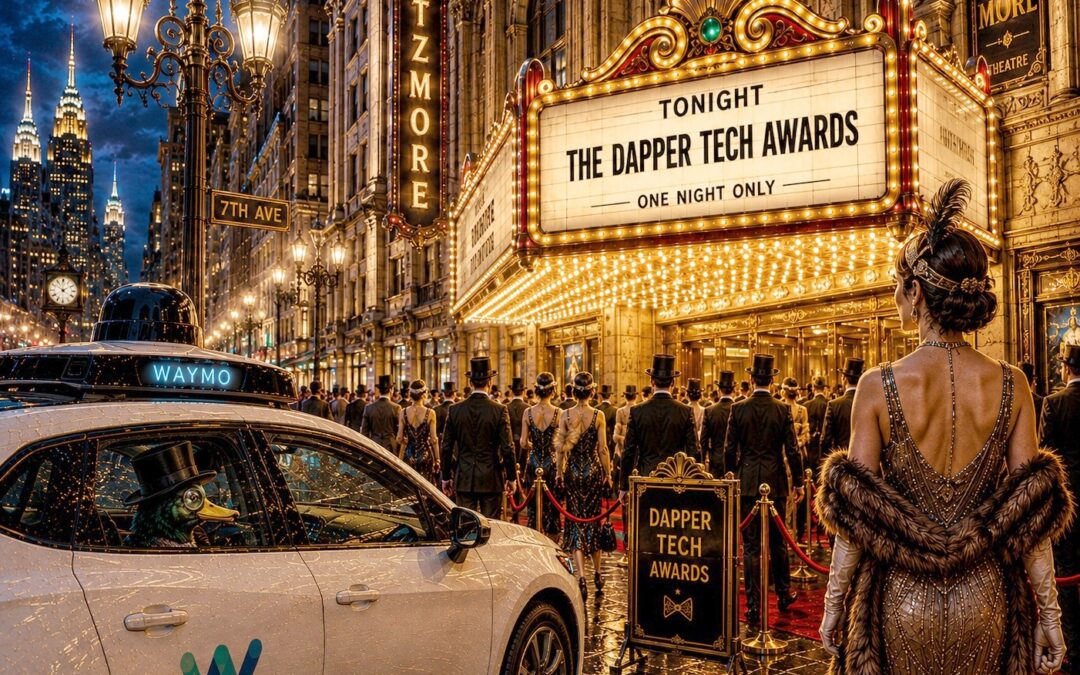
And one extremely well-dressed duck collecting an imaginary award.
Apparently, they meant it. 🦆🎩
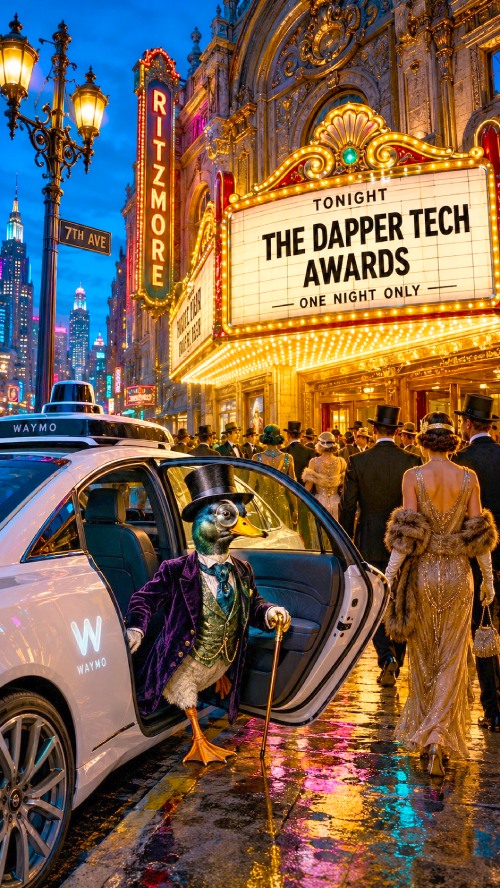
Somewhere between Art Deco and autonomous vehicles, chronology stopped asking permission.
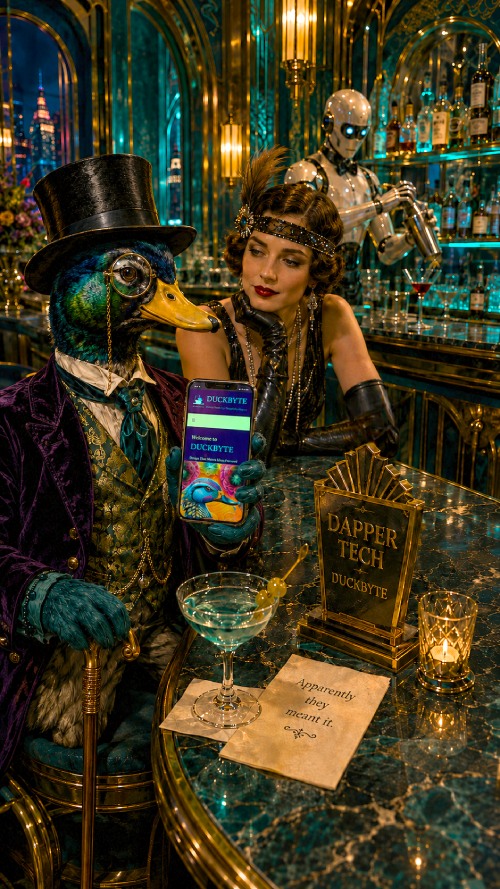
The robots got the bar. The duck got the girl. Make of technological progress what you will.
For the record, “Dapper Tech” came from Google Labs’ Pomelli. DuckByte takes no responsibility for what followed.
The philosophy here at DuckByte is simple: leverage AI for what’s creative and possible while keeping human creativity, judgment and oversight firmly in the equation.
But there’s another side to AI that’s becoming increasingly important for businesses online.
AI isn’t just helping us create things. It’s increasingly reading, interpreting and recommending them.
Which for your business website raises an interesting question:
How does AI see your business?
Does your website communicate clearly enough that an AI system can understand what you do?
More importantly, can AI understand what makes you different from everyone else doing some version of the same thing?
Your mission. Your values. Your personality. The things that aren’t easily reduced to a list of services and keywords.
So DuckByte became its own experiment.
Letting AI read the room
The DuckByte website was run through Pomelli, a free experimental Google Labs tool that analyzes a website and creates what it calls a business’s “Business DNA.”
Before generating marketing assets, Pomelli attempts to understand the business itself: its voice, values, aesthetic, messaging and overall identity.
That was the interesting part.
The point wasn’t to ask AI to tell DuckByte who it should be.
The question was whether AI could recognize who DuckByte already was.
And apparently, it could.
The voice it heard
Pomelli described DuckByte’s brand voice as:
Thoughtful. Playful. Subversive. Poetic. Witty.
Hard to argue with that. 😅
This may actually have been the most interesting part of the experiment.
Those aren’t services. They aren’t a list of SEO keywords. They’re qualities of communication.
Somehow, after reading the words, structure and presentation of the website, the system had picked up something closer to personality.
And that gets to the heart of why this matters.
A website shouldn’t merely tell people what you sell. Done well, it communicates something about who is behind it, what they value and how they think.
Increasingly, humans aren’t the only ones reading those signals.
That’s becoming part of the work of good web design: making sure AI understands what you do without translating your business into generic internet beige.
Then things got strangely specific
Pomelli identified DuckByte’s brand values as:
Human Connection • Conscious Design • Innovation • Authenticity • Presence
That felt remarkably close to the intention behind the site.
Then came the aesthetic analysis:
Digital Surrealism • Modern Professionalism • Digital Whimsy • Hyper-Saturated Surrealism • Dapper Tech
Also surprisingly accurate.
Although one member of the team may have taken Dapper Tech a little too seriously.
The larger experiment
The duck notwithstanding, there was something genuinely useful hiding inside this little experiment.
We’re entering an online environment in which people may increasingly encounter businesses through AI-assisted search, recommendations, summaries and other forms of machine interpretation.
That makes an old web-design principle newly important:
Clarity matters. Humanity does too.
Can someone understand what you do?
Can they understand why you do it?
and more importantly, can they distinguish you from the fifteen other businesses offering something superficially similar?
And after all of the keywords, structure and technical machinery have done their jobs, is there still enough humanity left in the signal for something unmistakably you to come through?
AI can help us build things faster. It can analyze, generate, organize and amplify.
But the goal shouldn’t be handing creativity over to the machine.
The interesting territory is the collaboration: human intelligence leveraging artificial intelligence, with human creativity, judgment and oversight still steering the ship.
Or, in this particular case, apparently steering the Waymo.
DuckByte’s experiment ended with an AI successfully identifying the business as thoughtful, playful, subversive, poetic, human-centered and professionally surreal.
And one extremely well-dressed duck collecting an imaginary award.
Apparently, they meant it. 🦆🎩