At DuckByte, we love emerging technologies. I mean—we can nerd out on them all day…
We’ll happily fall down a rabbit hole about SEO and structured data while sipping coffee like it’s a cosmic event.
But we also know our clients come to this world with… let’s call it a wide spectrum of enthusiasm.
Some love the shiny tech.
Some are terrified of the shiny tech.
Most are somewhere in the middle, like:
“I know I need this… I just don’t want to think about it too hard.”
That’s where we come in.
We monitor the market, study the flashy new trends, and—most importantly—distinguish the fluff from the stuff that’s actually going to matter six months from now. Then we integrate what genuinely makes sense into our content writing, website builds, and SEO offerings so our clients stay ahead without having to become full-time tech philosophers.

So let’s talk about the thing that’s actually making Google sweat through its pressed shirt: ChatGPT.
Yes, Google is sweating.
Visible brow. Tiny towel. The whole thing.
From boardroom to throne room, the pressure is showing.
ChatGPT isn’t just “that little AI tool everyone’s playing with” anymore.
It’s rising so fast it’s basically skipping steps.
And here’s where things get interesting:
People are increasingly using ChatGPT the way they used to use Google — as a search engine.
But instead of clicking through ten links looking for the right info, they’re asking ChatGPT to do the digging: summarize, interpret, compare, prioritize, and then offer the top links to click. In other words, people aren’t just searching — they’re using AI to search, sort, filter, compare, and synthesize information—turning what used to be a multi-step process into a single, almost instant moment of clarity.
So is ChatGPT replacing Google outright? Not yet.
But the trend line is unmistakable—this is where user behavior is headed, quickly.
And Google knows it.
Which is why things got particularly interesting in September 2025, when Google disabled the long-standing ability to retrieve 100 search results in a single request, effectively reducing that view to the standard 10.
That’s not just a technical tweak.
That’s Google tugging at its collar.
That’s Google saying: “We feel this.”
When the old king starts pacing the castle walls at night, you know the new era has begun.

Then came the real plot twist.
ChatGPT launched its own browser.
Yes.
Its own browser.
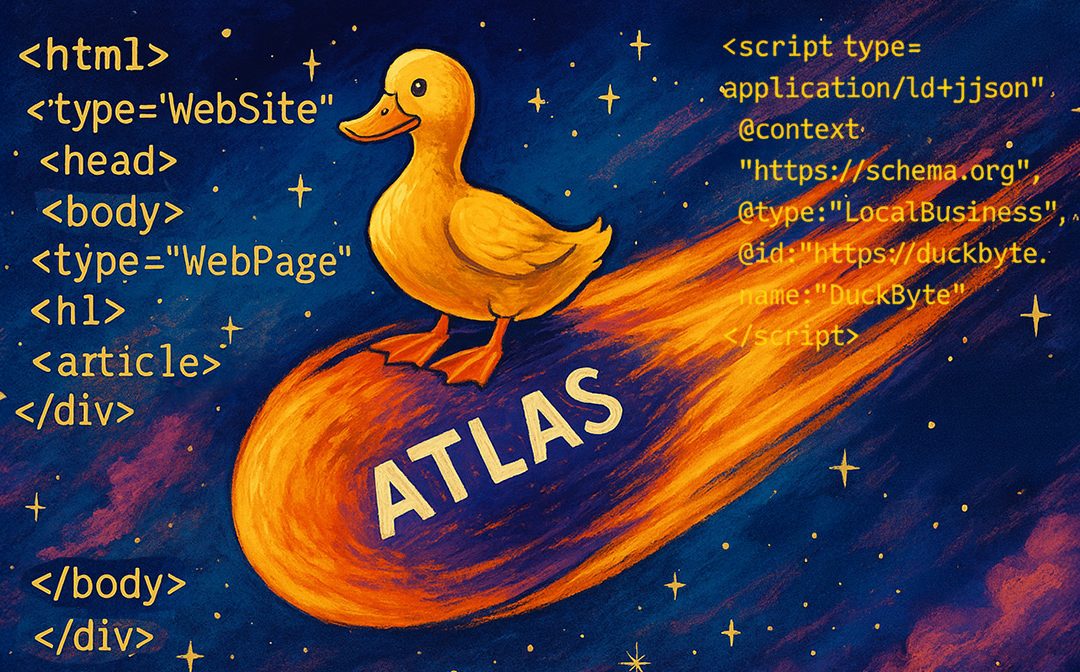
Enter Atlas—a full AI-enhanced browsing experience. And because the universe enjoys dramatic timing, this launch happened alongside an actual comet in the sky named, you guessed it… Atlas.
Coincidence? Probably.
Will DuckByte absolutely mention it anyway?
Of course.
Because that’s our charm:
We disarm the intimidating stuff with wonder, humor, and the occasional cosmic wink.
It makes things memorable.
It makes things human.
And it helps people ease into this new landscape with curiosity instead of dread.
But the important part is this:
Whether through Atlas or through the way people are already using ChatGPT to read the web for them, AI-first browsing is no longer theory. It’s here.
And it changes how your website gets read.
So what does this mean for your website?
Good news: if you’ve already written clear content with solid headings, you’re ahead of the pack.
But now the game has changed.
If people are going to “browse” your website through ChatGPT—meaning ChatGPT is the one reading, summarizing, and deciding what’s important—your content needs to be structured in a way that teaches the AI:
“This is what this page is.
This is what matters.
Show this first.
Don’t get confused.
Here’s the meaning.”
That’s where Schema Markup comes in.
Think of it as part of SEO for the AI age—giving machines extra clues about who you are, what you do, and what matters most on your website.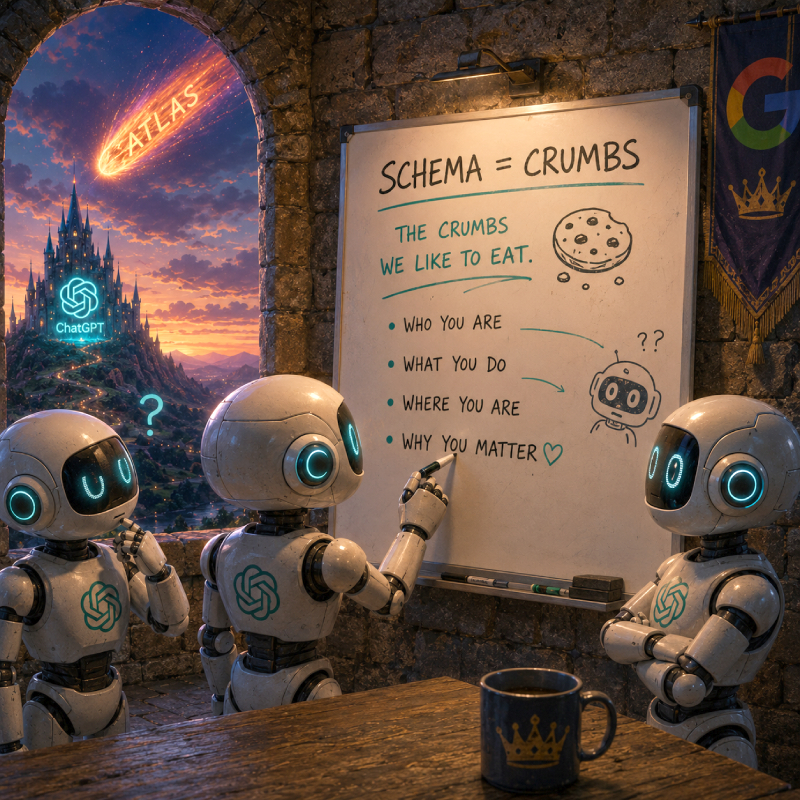
Schema: little clues that help the machines figure out who you are, what you do, and why you matter. Apparently, crumbs also work.
As AI increasingly reads the web on our behalf, those clues matter. You don’t want a machine squinting at your website thinking, “Okay… I think I know what these people do.” You want to make its job ridiculously easy.
And yes, “schema markup” sounds like a term invented by robots trying to unionize. But you don’t need to know how it works. That’s our problem.
What matters is the result: helping your business show up clearly and meaningfully in a world where machines are increasingly deciding what information gets put in front of humans.
Building for the internet that’s arriving now.
This new landscape isn’t scary for us—it’s thrilling. We’ve been building for clarity, story, and meaning long before “AI-first browsing” had a name.
DuckByte creates websites that:
- read beautifully to humans,
- give AI a better chance of understanding what makes your business matter,
- and are built for a web where search increasingly comes with an interpreter.
We handle the Schema, SEO, content, and technical details behind the scenes.
You don’t need to become an AI expert. You just don’t want your business getting lost in translation.
This is the new world of SEO—and we’re here for it.
Let us weave the clarity, meaning, and behind-the-scenes tech your website needs so you can show up beautifully in both the human internet and the AI-powered one that’s arriving fast.
Update, August 2026: This post was written in November 2025, when the tug-of-war between traditional search and AI-assisted discovery was moving especially fast. A lot has changed since then, but the larger question behind this piece has only gotten more interesting: as AI increasingly mediates how people discover and understand businesses online, what does it actually see when it reads your website? We decided to find out.